Five social factors strategies to overcome inferiority feelings

Inspired by Alfred Adler’s thoughts

It is important to be more mindful of the importance of social factors in developing personality and mental health. The sense of social inadequacy leads to inferiority feelings. Here are five practical ways that can help someone overcome inferiority feelings:

First, every person needs to explore and identify their strengths and abilities. Everyone has a unique set of talents and abilities. So, recognizing and developing these strengths and then learning to pursue activities to develop these abilities are necessary.

Second, every person needs a positive social support system. Healthy social relationships are essential for mental health and well-being. The presence of supportive friends and family members who can provide emotional support and encouragement is noteworthy.

Third, the ability to challenge negative self-talk needs to come to an awareness. Negative self-talk and self-criticism were major contributors to feelings of inferiority. Therefore, identifying, challenging, and replacing negative self-talk with more positive and constructive ones is paramount.

Forth, having a sense of purpose and direction in life to identify and pursue meaningful goals is essential for mental health and well-being.

And fifth, it is necessary to have healthy coping mechanisms for dealing with daily stress and setbacks. Every person needs to believe in the ability to cope effectively by developing routines, mindfulness activities, and creative pursuits. In addition, commitment, consistency, and persistence undoubtedly build resilience, which increases mental immunity.

Overall, overcoming feelings of inferiority requires a compassionate and supportive approach that emphasizes every person’s unique strengths and abilities. So, by providing a positive and empowering environment, every person continues developing the confidence and self-esteem to thrive.

DR. Rony Kusnadi Ph.D., LCPC
Notable Life Counseling Services LLC

verified by Psychology Today

 verified by GoodTherapy.org

Building Self Confidence

Building self-confidence is an ongoing process that requires consistent effort and willingness to step outside your comfort zone. Here are some tips to help you boost your self-confidence:

  1. Identify your strengths and weaknesses: Make a list of your strengths and weaknesses. Focus on your strengths and find ways to build on them. When you know your weaknesses, you can work on improving them.
  2. Challenge negative self-talk: Negative self-talk can be a significant barrier to building self-confidence. Whenever you think negatively about yourself, challenge those thoughts and replace them with positive affirmations.
  3. Practice self-care: Taking care of yourself can help boost your confidence. Practice self-care can include getting enough sleep, eating well, exercising regularly, and doing things that make you happy.
  4. Set achievable goals: Set achievable goals for yourself and work towards them. When you achieve your goals, it will help boost your confidence.
  5. Step outside of your comfort zone: Facing your fears and overcoming new challenges can help you build self-confidence. Start small and work your way up to bigger challenges.
  6. Surround yourself with positive people: Surround yourself with positive and supportive people. They can help you build your confidence and offer encouragement when you need it.

Remember, building self-confidence takes time and effort, but it is possible. So be patient with yourself and keep working towards your goals.

DR. Rony Kusnadi Ph.D., LCPC

Notable Life Counseling Services LLC

verified by Psychology Today

 verified by GoodTherapy.org

Quiet, peaceful, and still

Quiet, peaceful, and still.
when you let go,
when you learn the art of surrender
you are stronger
you are more in control
you embrace wisdom
Quiet, peaceful, and still.
That is the way of the path.
All come naturally
when you let go
more in control
more wisdom
more faith
more trust
more learning
and growth
with assurance
with hopeful imagination
life-optimism
to be better
and
always
be better
it is you
Quiet, peaceful, and still.
It heals, loves, and it is you.

DR. Rony Kusnadi, Ph.D
Notable Life Counseling Services LLC

verified by Psychology Today

 verified by GoodTherapy.org

Exploration of who you are

To Dear Friend,

This assignment is to explore who you are. It is the way to know yourself better and enables you to draw a starting point from where and to where you want to go. These are some conditions that you need to incorporate before beginning your personal journey:

First, you need to make this journey your priority so that you will have a special certain available time every day to sit with yourself and start to write/journey;

Second, you need to be patient and gentle toward yourself—sometimes, you will journey through the uneasy events in your past, which is okay because it is for better understanding and healing. It is probably hurt, and it is okay because you want to improve in the future. Because you do not want to fall into the same false repetitive behaviors

Third, you need to unmask yourself. It is hard because sometimes you do not want to see the real you. You don’t want to see who you really are. It is hard to become real who you are. It would help if you were open and honest towards yourself;

And fourth, the most important part is that you believe this exercise is not only an exercise. This exercise is your journey and will give you many benefits to better understand the NOW and develop the plan for TOMORROW/FUTURE.

  • Fill in the blanks on the age periods that apply to you (My Personal Time Line). This is your first personal self-inventory work.
  • Rewrite the blank paper the information by adding the content and description of the events, the positive and negative moments, the feelings, and the thoughts to know the interactions better. Considering to include the relevant childhood experiences (The interaction with parents and other family members as your inner circle and the extended ones—such as your friends, your neighbors, and your environment), developmental (the conditions how you grew up and how you are affected).
  • Closing your journey with how much you, NOW, are different than your past (describe it); How many parts of you still remain the same with your past (describe it); and how much you want to change (to grow)! Answer this question to identify your future: What does it mean to be the best version you are?

Learning to be the best version of yourself is the greatest way. It is about focusing on the Lessons. You will continue to grow better, stronger, and more amazing every day. You can rejoice in your unlimitedness because you can see the opportunities and possibilities.

Good Luck!

My support and prayers

DR. Rony Kusnadi Ph.D., LCPC

Notable Life Counseling Services LLC

verified by Psychology Today

 verified by GoodTherapy.org

PREPARING FOR THE COMING KAIROS

Kairos is a Greek word.
Kairos is different from Chronos (i.e., Chronology).

Chronos is concrete.
It is a human attempt to systemize the order of God’s creation.
It is a human attempt to measure time in an orderly fashion so we can create a schedule, work on our achievements by making plans, and reach our goals effectively.

It is really valuable in our hands if we use it well.
Chronos is determined by the flesh.

Kairos is abstract.
It refers to the appointed time, the right time, the fullness of time, and the time of opportunity for action or change. In theology, it is to describe the qualitative form of time. Sometimes we say, “Oh, this is my day! I got it!” for unexpected things happen, and we love to have it.

The tragedy of being ignorant of our Kairos is that when it is over, it is over. One of our windows of destiny that was offered would be closed. The river will never be in the same place twice. The Kairos moment may never return again!

Have you ever watched the drama & romance movie “Serendipity?” It is about a small event that can probably change your life!

We often get caught up with chronos and rarely discern the Kairos moment.

We tend to be unconscious of our Kairos moments, having no idea when our time arrives or our time to change begins. We have no idea how blessed we are as persons—as the ones who have so many blessings!

We tend to be unconscious to connect to our inner movement. The awareness to experience the love around us is really important. That God, The Ultimate Power, had and has been touching us at every moment and every event personally, when we wake up in the morning, when we close our eyes at night, and even when we are in our deep sleep.

Hope we are more than these simple experiences:

[Jeannette opens her senses to the presence of God. Waking up in the morning. Saying thank you for the blessing of the new day. Washing her face with warm water, then brushing her teeth. Doing some little makeup. Then, drinking a cup of tea. Sitting on her porch, watching the sunrise for a couple of minutes. Walking with her Debbie, a little cutie Yorkie puppy girl, through the valley, passing a beggar on the street. Helping an old lady crossing the busy morning street. Returning back home. Nursing her baby. Teaching her boy to tie a shoe. She smiles when she sees how different her boy is from one day to another. Watching mindfully how much her boy had grown up! Working in the shelter. Helping to cook for the homeless! Listening to the wounded one who needed to be listened to. Taking some time for herself, sitting in her own space/gap. Reading the scripture. Experiencing the meaning of being and being peaceful in silence. Jeannette makes herself ready to catch her Kairos.]

How far have you prepared for your personal Kairos! You need “Chronos” to form the new chapter of your life! Here and NOW.

DR. Rony Kusnadi Ph.D., LCPC
Notable Life Counseling Services LLC

verified by Psychology Today

 verified by GoodTherapy.org

Be Still, Calm, & Trust

[Be still in the silence. Listen to the God without and within. When you hear the sounds, it has to come to listen to the voices. But be aware not to listen to the voices as the sounds. The divine, our risen Lord, is present in every moment and place. God rewards those who earnestly seek Him (Hebrews 11:6)]

[Tips: When we are in trouble—when the sounds and the voices become chaotic: Be still and take deep breaths. Under these circumstances, we often forget to breathe deeply, so we hear the air expand our chest and rush through our nostrils. So be still and welcome the calm and quiet as you invite your Lord to come and stay, or either way, you visit God’s heart or home.]

DR. Rony Kusnadi Ph.D., LCPC
Notable Life Counseling Services LLC

verified by Psychology Today

 verified by GoodTherapy.org

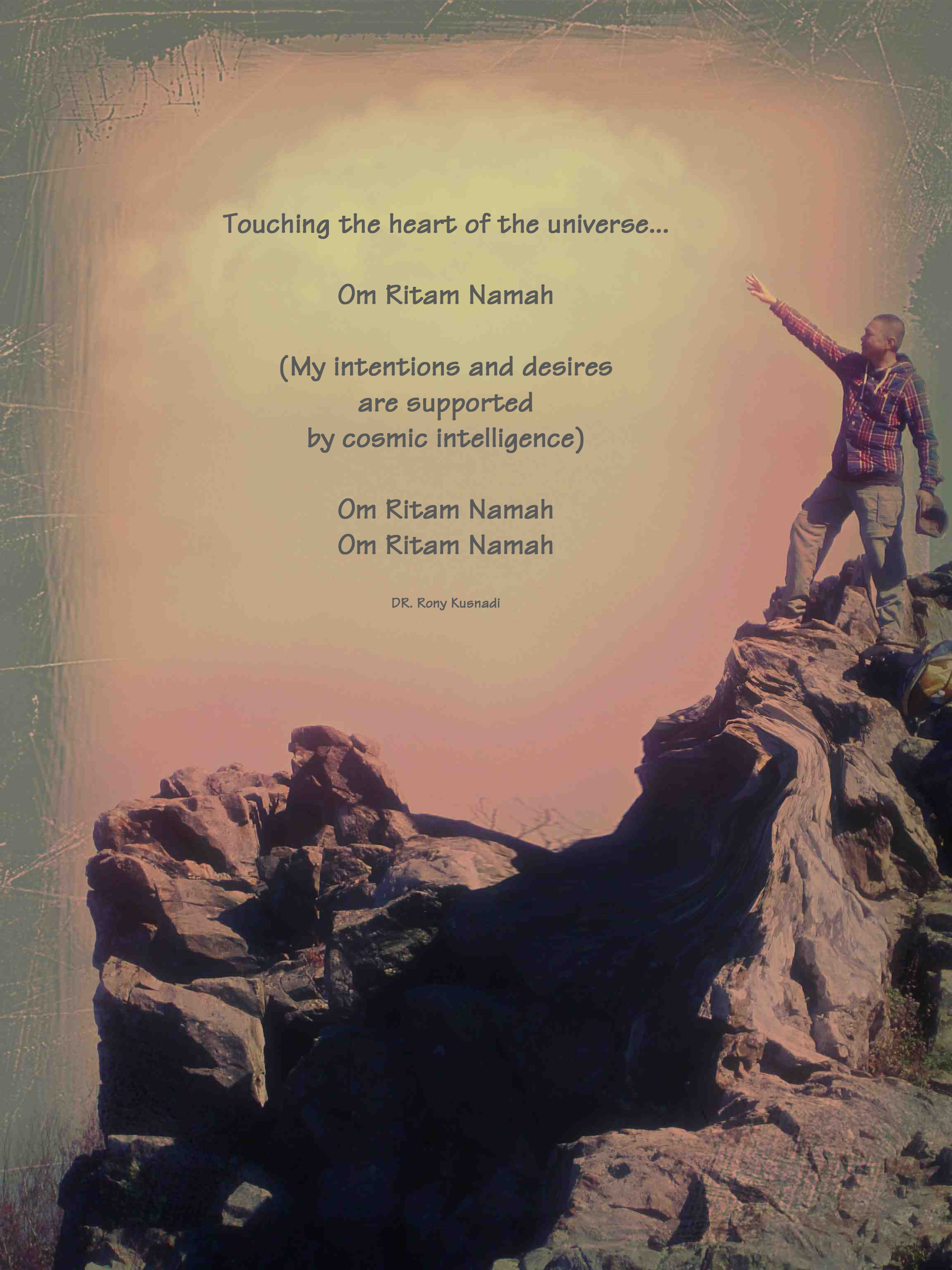
Om Ritam Namah

TouchingHeaven_Fiction_OmRitamNamah

Let the tranquility of mind and heart guide the inner path. First, let your core engage in a pose and be fully present. Then let the whole of you experience the warm presence of cosmic intelligence. Om Ritam Namah. Cherish the purity of desire and intentions to embrace the light of the true self. Let the cosmic intelligence then teaches how to relinquish attachments. Let it guide you through releasing inner resistance, increasing its flexibility, unfolding, liberating, and transforming. Om Ritam Namah.

Let the “Truth” and the “Knowledge of Reality” dances with the “Surrenderness of the EGO.” This dance opens the sense of self to receive a higher awareness of ALL THAT IS. Om Ritam Namah is the sacred dancing within for the one who opens him/herself to the truth of reality and an awareness of the universal energy, or God-force.

DR. Rony Kusnadi Ph.D., LCPC
Notable Life Counseling Services LLC

verified by Psychology Today

 verified by GoodTherapy.org

https://www.psychologytoday.com/profile/445711

Embrace daily salvation!

The “there” is over here; because the “here” is over there. I have faithfully planted these heavenly seeds and let them grow daily. So, my little mind can embrace and cultivate them wholeheartedly.

The next day, when I woke up, I had hopeful imagination and determination. Excitingly, I am making another “there” every morning. Then, when I go to bed, I go to bed with satisfaction because I have been unlocking the best version of myself. This is one of the happy moments in my life.

This happy moment becomes more and more plentiful and beautiful. My commitment, consistency, and persistence in cultivating make these seeds grow amazingly. I am certainly better, healthier, and happier every day. Truly, salvation happens when I embrace each day with a faithful heart.

[Things you do wholeheartedly, with purpose and mission, make the “there” happen here.]

Amazingly you are becoming what you want to become!

DR. Rony Kusnadi, Ph.D., LCPC
Notable Life Counseling Services LLC

verified by Psychology Today

 verified by GoodTherapy.org

Whatever happen happens

Whatever happens, let happen • We need to relinquish control, fear, worry, desire, and anger to be present, receptive, and aware • We cannot live in the future or our head • We must feel from the heart and bypass brain to connect to people • Self- doubt is a barrier to our journey of self-discovery, acceptance, and self-love • We deserve to reach our full potential • We deserve to love and to be loved • We can begin to heal. • The healing journey will be painful • We can work past the pain with quiet mind • Arrogance and defensiveness must be rid for healing to be effective • For each other to heal, we must heal ourselves first • Shame, guilt & reluctance must be absent • We will never find what we don’t seek, and sometimes our minds deceive us • We must lead with love as to enhance the ability to empathize good surprises with deep emotional reciprocation (i.e., Frisson: a sudden feeling of excitement or fearespecially when we think that something is about to happen).

[shenandoah synopsis by shenanjoah]

Notable Life Counseling Services LLC

verified by Psychology Today

 verified by GoodTherapy.org

Good surprises are always around you!

“You can control many things in life, yet you cannot control the whole thing. Because of that, the whole thing you cannot control is much bigger than you can control. So then, actually, there will be surprises-both good and bad. The challenge is that the brain looks at the bad instead of the good. That is the reason the good surprises feel like they happen less. Actually, it is not the case. Again, remember that you can control how you respond instead of reacting. How can you plan to be a winner instead of a follower or victim? In the case of embracing the surprises, you need to learn a radical acceptance first, which is to let go of the mind’s tendency to the bad surprises and start developing a positive mindset. Then, amazingly, you will be better off because you tune in your mind and heart to good surprises with hopeful imagination. So, you always seize the day wholeheartedly because you believe that good surprises are always around you!”

DR. Rony Kusnadi Ph.D., LCPC
Notable Life Counseling Services LLC

verified by Psychology Today

 verified by GoodTherapy.org